
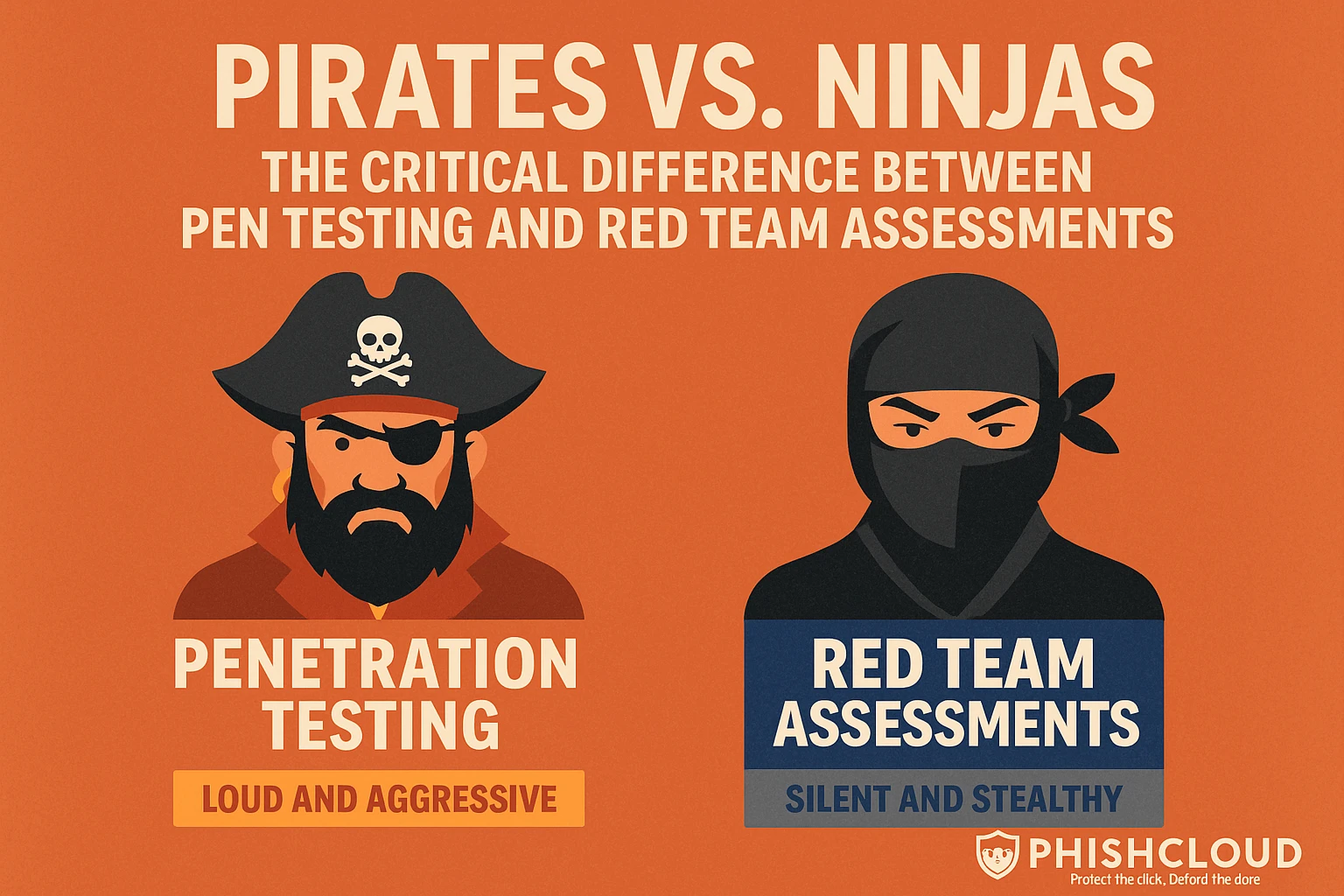
Pirates vs. Ninjas
The Critical Difference Between Pen Testing and Red Team Assessments
Pen Tests Check Boxes. Red Teams Prove Resilience.
Why This Matters: The $4.44 Million Cost of Getting It Wrong
The average data breach in 2025 costs organizations $4.44 million globally. But that's just the average. Healthcare organizations face $7.42 million per breach, while financial institutions pay $5.56 million.
These numbers aren't just statistics. They represent operational downtime, regulatory fines, damaged reputation, and lost customer trust. And they highlight a critical question: Are you testing your security defenses the right way?
Most organizations run penetration tests annually and assume they're protected. But pen testing alone isn't enough to stop sophisticated attackers who use stealth, persistence, and evasion techniques your security tools might not detect.
Pirates vs. Ninjas: Understanding Two Approaches to Security Testing
Think of penetration testing as pirates. They're loud, direct, and focused on finding as many treasures (vulnerabilities) as possible. They don't care if you know they're coming because their job is to catalog what's weak.
Red team assessments are ninjas. They operate in stealth, bypass your defenses undetected, and focus on specific objectives, like accessing your most critical data or systems without triggering alarms.
Both are essential, but they serve different purposes.
Penetration Testing: The Comprehensive Vulnerability Hunt
Penetration testing is a structured, compliance-focused assessment designed to identify as many vulnerabilities as possible across your systems, networks, and applications.
What It Tests
Network Infrastructure
Vulnerabilities in routers, firewalls, and network protocols
What It Tests
Application Security
Weaknesses in web apps, APIs, and mobile applications
What It Tests
System Misconfigurations
Configuration flaws in systems and cloud environments
What It Tests
Authentication & Access
Flaws in authentication mechanisms and access controls
Key Characteristics
3-6 Week Duration
Testing typically spans several weeks for comprehensive coverage
Key Characteristics
Announced Testing
Security teams are aware testing is happening
Key Characteristics
Severity-Prioritized
Findings ranked: critical, high, medium, low
Key Characteristics
Compliance-Driven
Often required for PCI DSS, HIPAA, ISO 27001
Red Team Assessment: The Real-World Adversary Simulation
A red team assessment simulates a real-world cyberattack by highly skilled adversaries. The goal isn't to find every vulnerability, it's to test whether your security defenses, detection tools, and response teams can stop a targeted attack.
What It Tests
Detection Capabilities
SIEM, EDR, IDS/IPS effectiveness at catching threats
What It Tests
Incident Response
How quickly and effectively your team responds to threats
What It Tests
Security Awareness
Success rates of social engineering attacks on staff
What It Tests
APT Detection
Ability to detect and respond to advanced persistent threats
What It Tests
Real Attacker TTPs
Emulating actual tactics, techniques, and procedures
Key Characteristics
Extended Timeline
Engagements span 3 weeks to several months
Key Characteristics
Stealth Mode
Security teams often unaware—testing real detection
Key Characteristics
Goal-Oriented
Access specific data or systems undetected
Key Characteristics
Multi-Stage Attacks
Uses social engineering, physical, and digital penetration
Key Characteristics
Nation-State Emulation
Mimics advanced APT and nation-state tactics
Three Critical Differences Between Pen Testing and Red Team Assessments
Pen testing finds vulnerabilities. Red teaming proves whether your defenses work against real attacks.
Penetration Testing
Breadth
Broad scope testing multiple systems, networks, and applications to catalog as many vulnerabilities as possible.
Red Team Assessment
Depth
Narrow, focused scope on specific objectives like accessing crown jewel data or critical systems.
Penetration Testing
Announced
Your security team knows testing is happening, so defenses are on alert and ready.
Red Team Assessment
Unannounced
Your team doesn't know (except select executives), testing real-world detection and response.
Penetration Testing
Compliance
Proves compliance with regulations (PCI DSS, HIPAA, ISO 27001) and identifies vulnerabilities to remediate.
Red Team Assessment
Resilience
Proves resilience by testing your ability to detect, respond to, and contain sophisticated real-world attacks.
Penetration Testing
3-6 Weeks
Shorter, focused engagements with clear start and end dates for comprehensive vulnerability assessment.
Red Team Assessment
3 Weeks - Several Months
Extended campaigns mimicking persistent attackers with multi-stage operations over time.
Penetration Testing
Lower Investment
More cost-effective for regular testing cycles and compliance requirements. Ideal for establishing baseline security.
Red Team Assessment
Higher Investment
Premium service requiring specialized expertise. Best for mature security programs protecting critical assets.
Beyond Point-in-Time Testing: Continuous Protection
While both penetration testing and red team assessments provide valuable insights, they're point-in-time evaluations. Cybercrime is projected to cost $10.5 trillion annually by 2025, and attackers don't wait for your annual security assessment.
Organizations using extensive security AI and automation identify and contain breaches 80 days faster than those without. This is where continuous security monitoring, threat intelligence, and unified security operations become critical.
While pen testing and red team assessments are essential, consider how a Cyber Fusion Center can provide continuous threat detection, automated response, and real-time security orchestration to complement your assessment program.
Ready to Test Your Real-World Resilience?
Our OT-focused Red Team Assessments simulate advanced adversary tactics to stress-test your defenses without disrupting operations.
Learn About Red Team AssessmentsHow to Choose the Right Security Assessment for Your Organization
The question isn't whether you need pen testing or red team assessments. You need both, but at different stages of maturity.
For most organizations, a phased approach works best: start with vulnerability assessments, graduate to penetration testing, and layer in red team assessments as your security posture matures.
Final Thought
Compliance doesn't equal security. Passing a pen test is important, but it doesn't guarantee you can stop a skilled attacker.
If you're serious about resilience, you need both the pirates and the ninjas. And if you operate critical infrastructure or OT environments, you need assessments specifically designed for those unique challenges.
Learn more about OT-focused Red Team Assessments or explore how red team testing differs for operational technology.